Treatment Process
How does it happen in 72 hours? The treatment process, day by day
Three days, that is 72 hours: we go through which decision is made on which day, what happens on the evenings in between, and on which day treatment is completed
This page is not about why 72 hours is possible, but about what happens within it. We have set out, in order, what is done on each of the three clinical days, what is expected of you on the evenings in between, what is complete by the end of day 3, and why this timetable runs longer for some people.
Short answer
Treatment is spread across three days, that is 72 hours. On day 1, before surgery the plan is reassessed with a 3D CBCT scan, the implants are placed under local anaesthetic, and your first try-in teeth are made the same day. On day 2, several try-ins settle your bite, tooth shape, speech and final shade. On day 3, the final fixed teeth are fitted onto the implants, the last bite adjustment is made and treatment is complete; you can go home at the end of day 3. Further check-ups follow the clinic's follow-up plan. This timetable is the result when conditions are met, and it may not move at the same pace in every case.
- Treatment length
- 3 days (72 hours); treatment finishes on day 3
- Day 1
- Surgery, with first try-in teeth the same day
- Day 3
- Final fixed teeth and the last bite adjustment
- When this timetable runs longer
- If anchorage torque is low or extra preparation is needed
Medically reviewed by Bilge Ilgın, Dentist · Implantology
Three days, 72 hours: what happens in what order
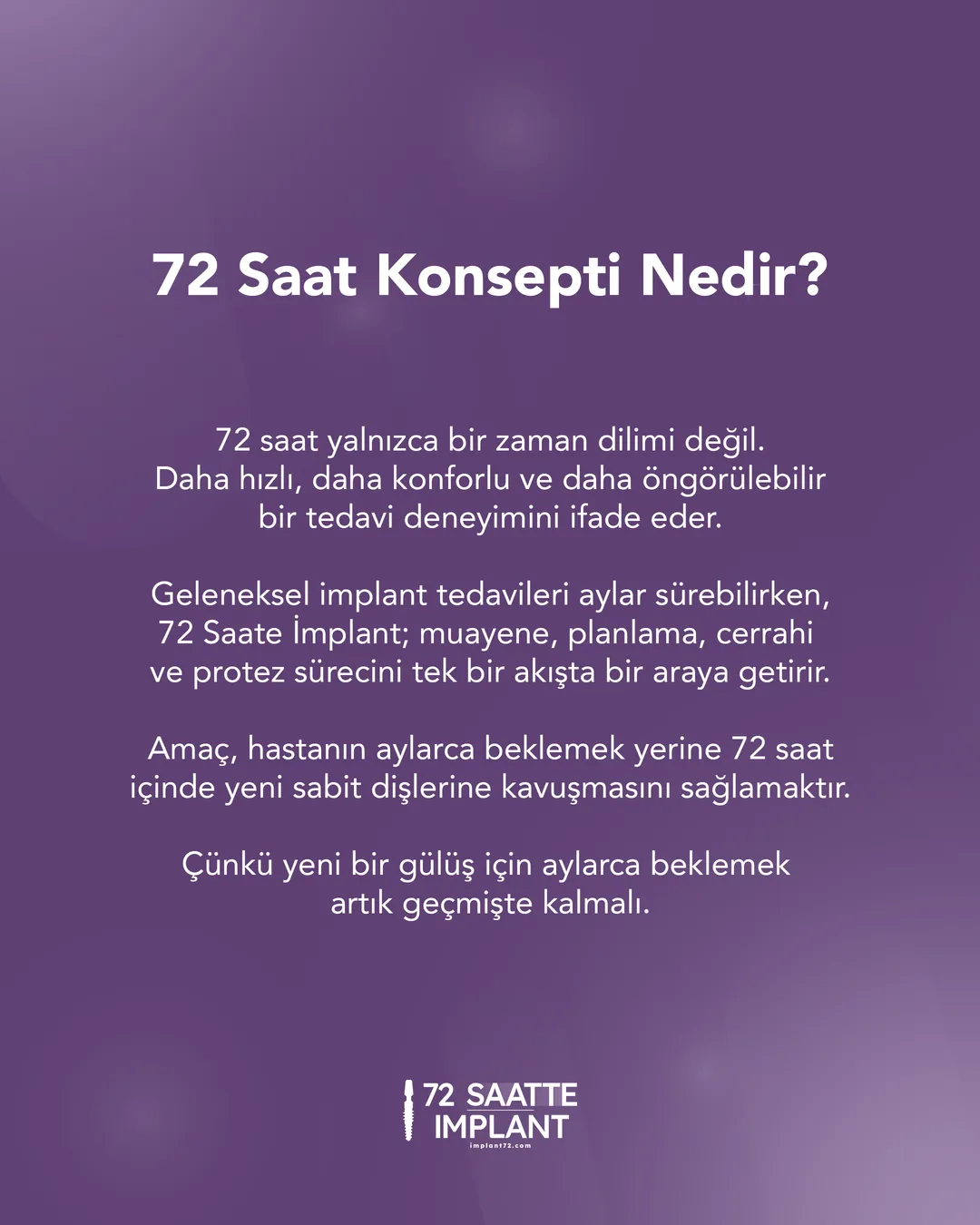
The 72-hour concept is a way of bringing together, in one visit, a process that can otherwise stretch over months from the first consultation to the delivery of the bridgework. With conventional implants, planning, surgery and the bridgework are spread across separate appointments and weeks; here, all three happen during the same visit, as steps that follow on from each other. The aim is to send you home with your new fixed teeth within 72 hours, instead of making you wait for months. We cover where the implant gets its anchorage in the bone, and why that shortens the wait, in detail on a separate page; this page is about what is done in what order across the three days, not about the source of the anchorage.
The process is a carefully planned three-day sequence that runs from implant surgery to the final fixed teeth. Each day builds on the outcome of the one before: on day 1 the implants are placed and your first try-in teeth are made, on day 2 those try-ins are used to settle your bite and appearance, and on day 3 the decisions that have been settled become the final teeth. This order is not arbitrary; no decision for the next day is made until the outcome of the previous one has been seen.
The reason the three days are needed separately is not how long the surgery takes, but that the bite and the appearance are settled over several steps. The surgery itself takes a few hours; what really takes time is adjusting the position, height and colour of the teeth with you across more than one try-in. Squeezing this step into a single day would leave your bite and appearance to an unreliable guess; three days is the shortest sequence that gets there without skipping any of the try-ins.
You leave the clinic with your final teeth at the end of day 3; treatment is complete and you can go home. There is no further stage still to come for your teeth; what remains is follow-up: further check-ups are carried out according to the clinic's follow-up plan, healing is monitored, and a small bite adjustment is made if needed. If a night guard has been planned to protect your teeth overnight, that is also part of this follow-up. Treatment finishing on day 3 does not mean follow-up is over; check-ups exist so that the early period of healing can be watched closely.
Something is also expected of you during the hours outside the clinic. Cold compresses and soft food on the night of surgery, following the instructions given between the try-ins on days 2 and 3, and controlled chewing once the final teeth are fitted are all part of the timetable. We have set out these details separately in the day-by-day plan below.
Let us say this plainly: this timetable is not a promise but an outcome that follows when conditions are met. If an implant does not sit in the bone with the expected resistance during placement, that area is not loaded that day and the final tooth for that implant is delayed. If a bone graft or extra preparation is needed, the three-day timetable is not followed as it stands from the outset. We explain who this applies to, and why, in the next section.
Who this timetable moves at this pace for, and who it runs longer for
Whether the three-day plan runs as described or takes longer does not depend on what the patient wants; it depends on the bone seen on the CBCT scan and the anchorage measured during surgery. The points below are what is checked at your examination; the definite answer comes after imaging and surgery.
The tooth can be saved
- Patients missing several teeth, or planning full-mouth treatmentThis plan is not built for a single implant; when several implants work together the load is shared, and the final bridge can be delivered within the first three days. A single missing tooth does not have that shared load.
- Patients with enough bone, or where anchorage can be taken from the deep layerThe implant sitting with the expected resistance on the day it is placed is the condition for your first try-in tooth being made that same day. This is measured during surgery, not when you book the appointment.
- Patients whose general health will not delay treatmentAn uncontrolled chronic condition or a recent operation is something that needs to be addressed before the plan can be fitted into three days. You will be asked for a full list of the medicines you take at your first assessment.
- Patients who can set aside three consecutive daysBecause each day's try-in builds on the one before, a large gap between the days disrupts the plan. This is why it matters for patients travelling from elsewhere in Turkey or from outside Turkey to schedule the three days back to back.
Saving it is unlikely to hold
- Patients missing a single toothThis plan is designed for multiple missing teeth and full-mouth treatment. For a single gap, a conventional single-tooth implant means fewer procedures and a simpler plan.
- An active infection in the area, or a tooth that needs extractingThe infection is treated, or the tooth is extracted, first; this is a separate period added before the three-day timetable, and you are told about it from the outset.
- A noticeably reduced volume of boneIf a bone graft is needed, that area is left to heal first. In this situation the three-day plan is not followed as it stands, and the conventional timetable is used instead.
- The expected anchorage is not achieved during placementIf the bone is soft, the implant may not sit with the expected resistance. For that implant, the first try-in tooth is not made that day, and its delivery is delayed. This decision depends on the value measured during surgery, not on the patient's plan.
What happens, day by day
The sequence below shows the three clinical days and the evenings in between. There is no further stage for your teeth after day 3; daily care and check-ups carried out according to the clinic's follow-up plan are covered under a separate heading.
- 1
Before surgery: reassessing the plan
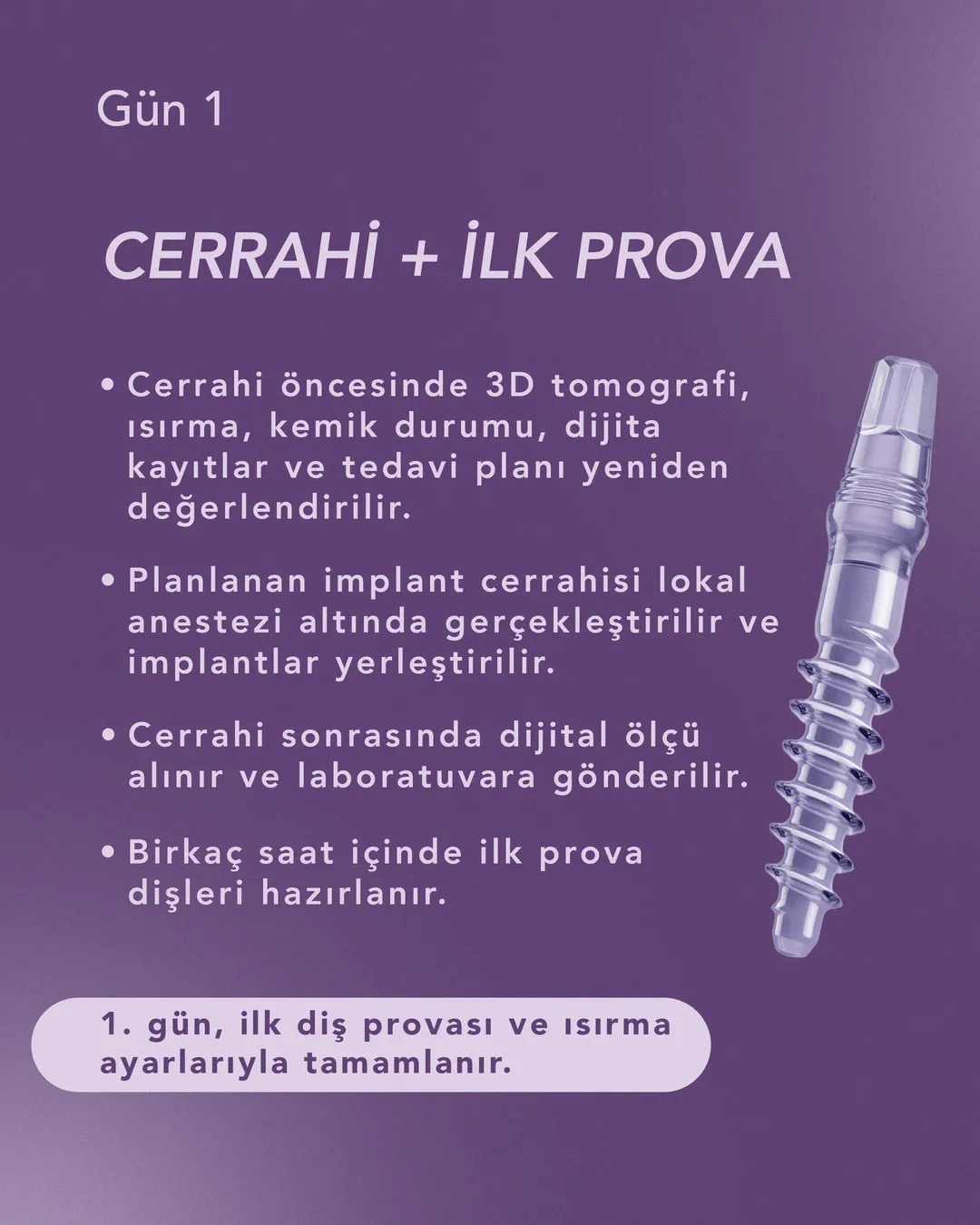
Before surgery, a 3D CBCT scan, your bite, the condition of the bone and your digital records are reviewed again; the treatment plan drawn up earlier is confirmed or updated against this scan.
- 2
Day 1: surgery and the first try-in
The planned implant surgery is carried out under local anaesthetic and the implants are placed. After surgery, a digital impression of your mouth is taken and sent to the laboratory; your first try-in teeth are made within a few hours. The day finishes with the first tooth try-in and a bite adjustment.
- 3
The evening of day 1: rest and the first night
Apply cold to the outside of your cheek, eat soft food, and take the medicines you have been given without missing a dose. Your mouth still feels new with the first try-in teeth in place; do not eat anything hard or sticky this evening.
- 4
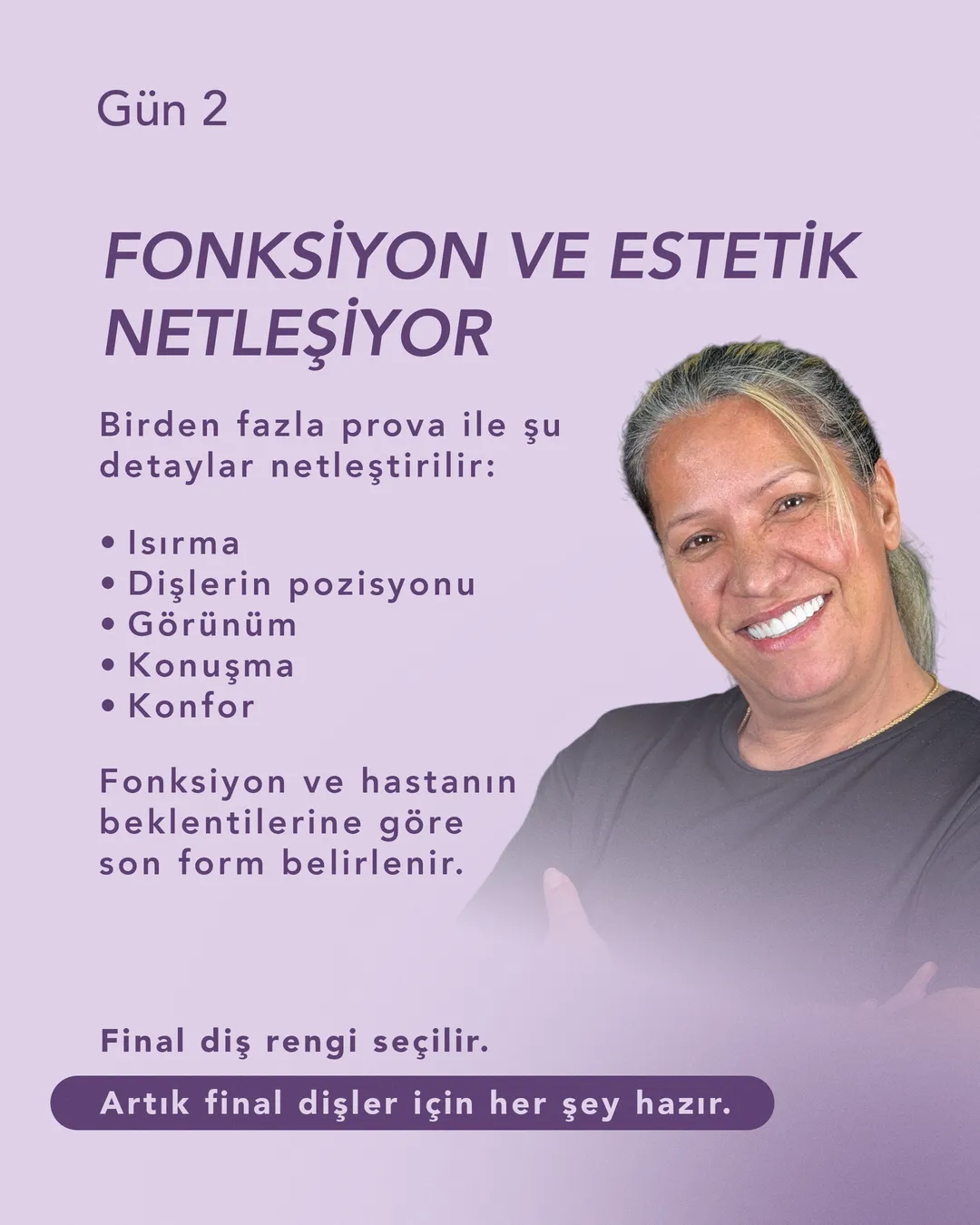
Day 2: function and appearance are settled
Several try-ins settle your bite, the position of the teeth, appearance, speech and comfort. The final shape is decided according to function and your own expectations; the final shade is chosen on this day.
- 5
The evening of day 2: preparing for the final day
The chosen shade and shape are sent to the laboratory, and the final bridge is made overnight. What is expected of you this evening is the same as the day before: controlled eating and following the instructions you have been given.
- 6
Day 3: the final day
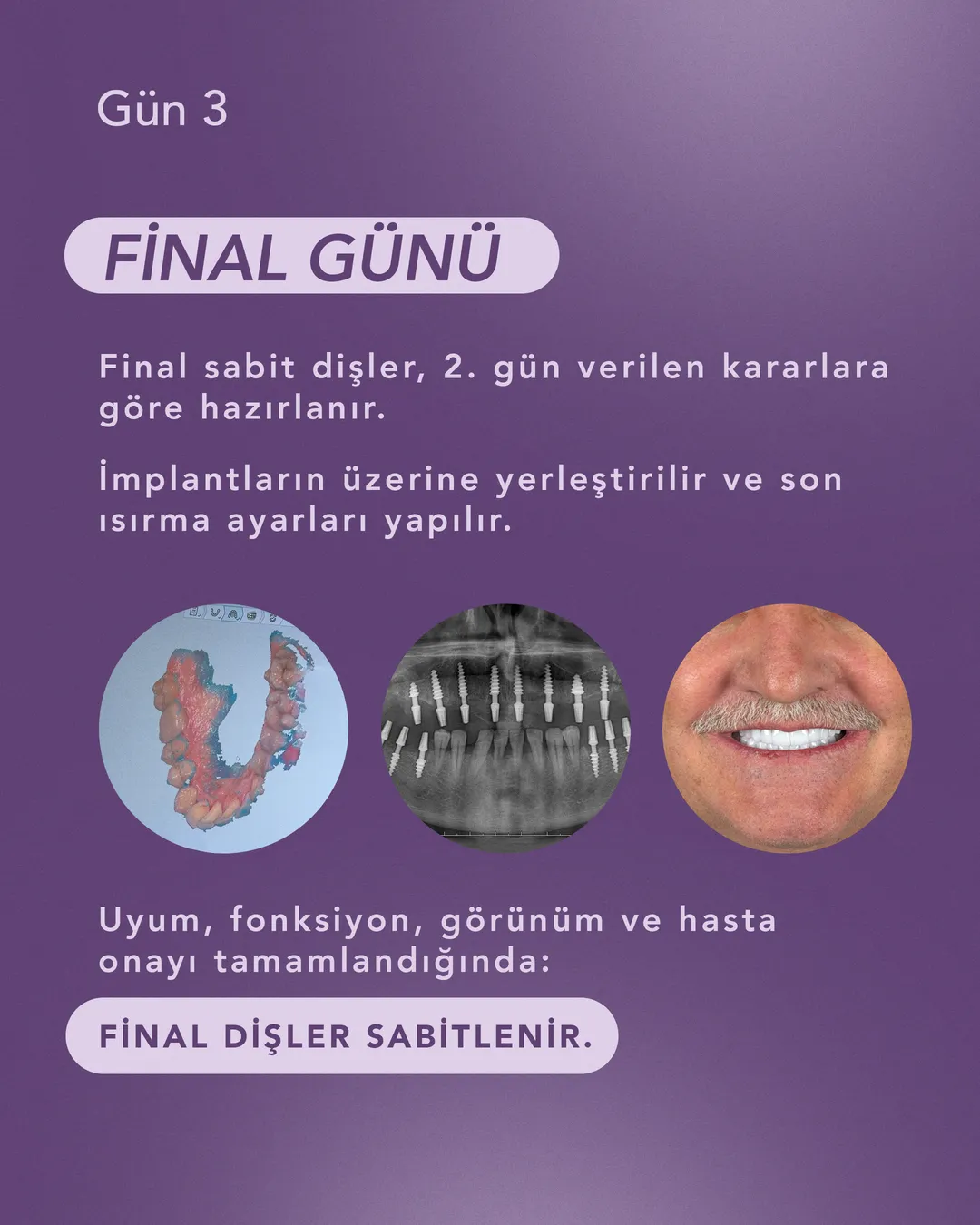
The final fixed teeth, made according to the decisions settled on day 2, are placed onto the implants and the last bite adjustments are made. Once fit, function, appearance and your approval are all complete, the final teeth are fixed in place.
- 7
The end of day 3: treatment is complete
You leave the clinic with your final teeth; treatment is complete and you can go home. Healing, though, continues: over the following days chewing is opened up gradually, and hard foods that would strain the area are avoided.
- 8
Afterwards: follow-up continues
The main course of treatment is complete at the end of day 3. Further check-ups are carried out according to the clinic's follow-up plan; healing is monitored and a small bite adjustment is made if needed. If a night guard has been planned, it is also part of this follow-up.
Situations where the timetable runs longer or changes
The plan above is not the only scenario. Depending on what is found at your examination, the same three-day structure changes in the following ways for some patients.
If an extraction or infection treatment is needed
If there is a tooth that needs extracting or an infection that needs treating, this is a separate step added before day 1. The three-day plan begins once this step is complete.
If the expected anchorage is not achieved in one implant
The first try-in tooth for that implant is not made on the day of surgery; the area is left to heal without being loaded. The other implants can go ahead as planned, and the final tooth for that area moves to a separate timetable.
If a bone graft is needed
If the volume of bone is noticeably insufficient, a graft is placed first and left to heal; this is a separate process that stretches over months. In this situation the three-day plan is not followed as it stands, and the conventional timetable is used instead.
What you need to know when reading this timetable
We are not writing the points below to put you off; they are so that, whichever clinic you go through this process with, you can ask the right question.
Three days is an outcome, not a promise
The timetable is the result when conditions are met. Loading an implant to keep to the day, even though the expected anchorage was not achieved, might save the timetable in the short term, but it can cost you the implant.
Speed does not mean a lack of checks
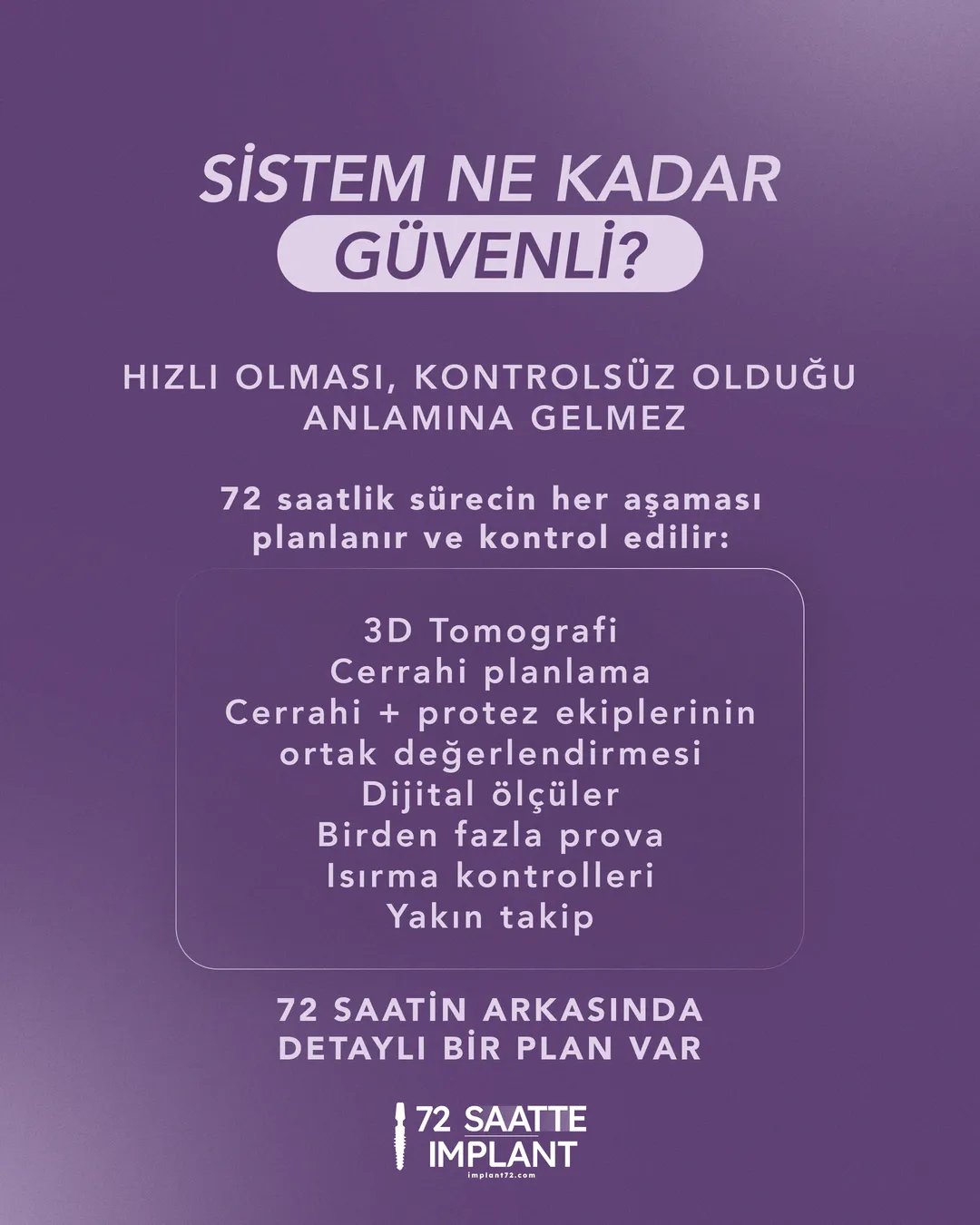
There is a check built into every step of the three days: the 3D CBCT scan, surgical planning, a joint assessment by the surgical and restorative teams, digital impressions, more than one try-in, bite checks and close follow-up. Moving quickly does not mean these steps have been skipped.
Leaving with your final teeth does not mean eating anything straight away
Leaving the clinic with your final teeth on day 3 does not mean healing is over. Controlled chewing still matters in the first few days; there is no need to rush into biting something hard on the first day.
The bite adjustment is the quietest but most decisive part of the job
The time set aside for the bite adjustment on the final day shows how seriously that clinic takes the work. A bite that does not spread the load evenly comes back within months as a loose screw or a broken bridge.
After day 3
Once treatment is complete on day 3, there is no further stage left for your teeth; getting used to living with your final teeth and long-term follow-up according to the clinic's follow-up plan begin. The plan below is how things go for most patients, and it can shift by a few days from person to person.
The first two weeks
Chewing gradually returns to normal, and your speech may feel different for a few days while you get used to the new surface. The gum keeps shaping itself around the final bridge.
The first month
The gum settles, and your bite is checked once more; any small differences in contact that showed up in the first few days are corrected at this point. This check-up is not one to skip.
Using a night guard
If a night guard has been planned and given to you, wear it regularly; this reduces the load that builds up on the final bridge overnight.
Long-term check-ups
How long your final teeth last depends on regular check-ups. The intervals are set according to the condition of your mouth; a schedule that is more frequent in the first year and spaces out afterwards is followed.
Message us right away if
- Swelling keeps increasing after the fourth day. Swelling is expected to increase in the first few days and then go down. Swelling that keeps growing after the fourth day, or a bad taste, can be a sign of infection; let your clinic know the same day.
- You notice movement or clicking in the final bridge. The final bridge is fixed and should not move. Even the smallest movement can be an early sign of a loose screw, and catching it early usually means it is fixed with a simple tightening.
- A single point in your bite touches down first. If you feel one spot make contact before the rest when you bite, the load is building up there; this is corrected with an adjustment that takes only a few minutes.
- You have a fever, spreading swelling or difficulty swallowing. These signs can mean infection has spread into the soft tissue. Call your clinic; if you are struggling to breathe, go straight to A&E without waiting.
What decides the scope of this timetable
We do not give figures on this page; the items that decide scope and timing become clear once the CBCT scan has been reviewed. These are the items that extend the timetable or change its content:
- Number of implants and jaws treated
- Whether one jaw or both is treated, and how many implants are planned, is the biggest item deciding the scope of the try-ins and the final work.
- Whether extra preparation is needed
- If an extraction, infection treatment or bone graft is needed, these are added before the three-day plan and extend the total timetable.
- The material of the final bridge
- The material used in the final bridge and the laboratory work together decide the scope of what is delivered on day 3.
- Night guard and check-up frequency
- Whether a night guard is planned, and how often check-ups are held in the first year, are part of the timetable beyond the three days.
Frequently asked questions
Are teeth fitted along with the implants on day 1?
Yes, your first try-in teeth are made the same day after surgery and fitted that day with a bite adjustment. These are not the final teeth; they become the final bridge based on the decisions settled on days 2 and 3.
Do I spend the whole three days at the clinic?
No. Certain hours of each day are spent at the clinic, and the rest of the time is when the laboratory is working or you are resting. The time between try-ins can be spent away from the clinic.
Why are there several try-ins on day 2?
Your bite, tooth position, appearance and speech are settled through several small adjustments, not in a single step. If this step is skipped, the bite adjustment on the final day can take longer.
Why are there still check-ups after day 3? Isn't treatment finished?
Treatment is complete with your final teeth at the end of day 3, and you can go home that day. The check-ups are not a new stage of treatment; they are part of follow-up: further check-ups are carried out according to the clinic's follow-up plan, healing is monitored, and a small bite adjustment is made if needed.
Is a night guard given to everyone?
No, only if it has been planned. Where one is planned, the night guard is used to reduce the load that builds up on the final bridge overnight. You can ask before treatment whether one is planned for you.
Will this timetable move at the same pace in my case?
The definite answer comes after the CBCT scan and the anchorage measured during surgery. If an extraction, infection treatment or bone graft is needed, the timetable is not followed as it stands; we tell you this from the outset.
Do I leave on the final day with final teeth, or something temporary again?
The final bridge is fixed in place once it has been fitted onto the implants, the last bite adjustment made, and your approval given; you leave the clinic on the final day with your final teeth. No other bridge is made to replace these teeth months later; any further appointments are check-ups carried out according to the clinic's follow-up plan.
Sources
Kartlarla gün gün süreç
Sosyal medyada paylaştığımız kartların aynısı. Yana kaydırarak cerrahi gününden final dişlere ve takip günlerine kadar sırayla görebilirsiniz.
Related pages
- Making the DecisionAre Fixed Teeth in Three Days Really Possible?Are fixed teeth in three days an advertising line or a clinical result? What shortens the time, what does not, what the teeth you are fitted with actually are, and who this plan does not work for.
- Coming for TreatmentFixed Teeth in 72 Hours in IstanbulHow the three clinical days actually work in Istanbul: what happens on which day, how many days to set aside, how much can be assessed remotely, and what to ask before you book.
- The ProcessWhat to Eat After Dental Implants? Day-by-Day NutritionWhat you can eat in the first day, first week and first month after dental implants: hot, hard, sticky and seeded foods, smoking and alcohol, chewing with your new fixed teeth.
Send your X-ray and we will tell you which option is realistic for your tooth.
Get an assessmentNext step
Send your X-ray and we will talk through the options.
Share your CBCT or panoramic X-ray. We will write back within 24 hours on which option is realistic for your tooth.